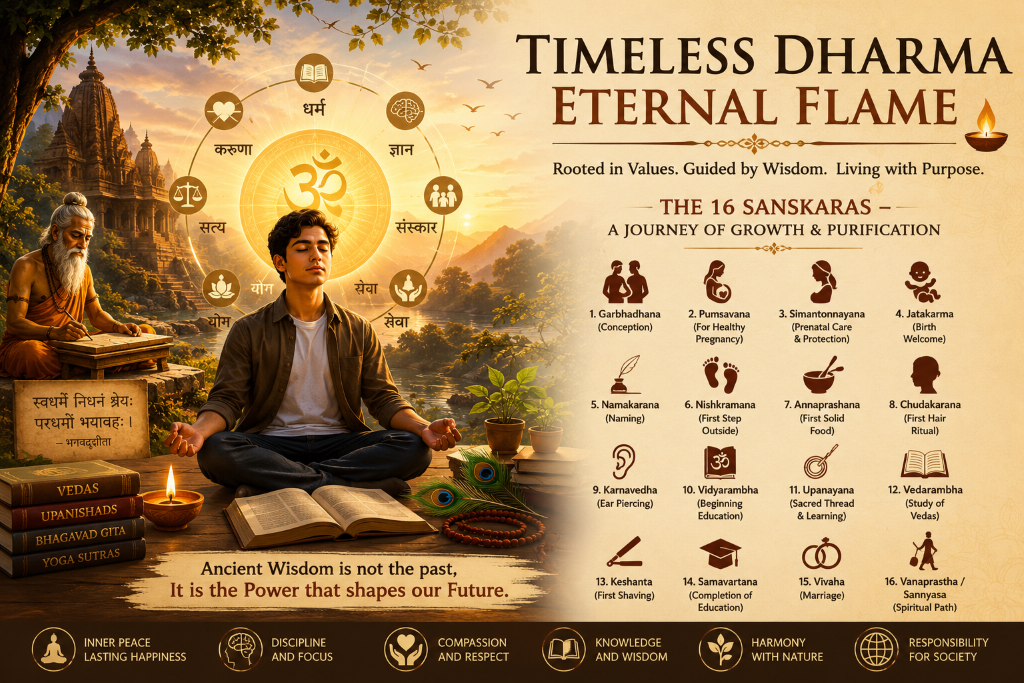
In a world driven by technology, speed, and constant change, success is often measured by achievements, wealth, and recognition. While these are valuable, they cannot replace the inner strength that comes from values, wisdom, and purpose. India's timeless spiritual heritage reminds us that true progress is not only about advancing outwardly but also about growing inwardly. Dharma is that guiding light which helps individuals live with integrity, compassion, and balance throughout every stage of life.
The word Dharma is often misunderstood as religion, but its meaning is much deeper. Dharma is the natural law that sustains harmony within ourselves, our families, society, and nature. It teaches us to perform our responsibilities with honesty, respect every form of life, seek knowledge with humility, and make decisions based on righteousness rather than personal gain. When Dharma becomes the foundation of life, peace naturally replaces confusion, and purpose replaces uncertainty.
One of the most remarkable gifts of the Vedic tradition is the concept of the Sixteen Sanskaras (Shodasha Samskaras)—a sequence of sacred milestones that nurture a person's physical, emotional, intellectual, and spiritual development. These ceremonies begin even before birth and continue through every important phase of life. They are not merely rituals to be performed, but meaningful reminders that every stage of life deserves awareness, gratitude, and responsibility.
Each Sanskara carries a timeless lesson. The early Sanskaras emphasize the importance of healthy beginnings, loving families, and positive values. As a child grows, education is celebrated not simply as the acquisition of information but as the awakening of wisdom and character. The sacred thread ceremony symbolizes discipline and lifelong learning, while marriage is viewed as a partnership built upon trust, commitment, and shared responsibility. Later stages of life encourage detachment from material attachment, selfless service, contemplation, and the pursuit of spiritual freedom.
Although modern lifestyles may not always allow every traditional ceremony to be observed, the principles behind them remain as relevant today as ever. Respect for parents and teachers, gratitude for nature, disciplined learning, ethical conduct, compassion toward others, and continuous self-improvement are timeless values that transcend generations. These ideals help create individuals who are confident, responsible, and emotionally resilient.
Today's youth face challenges that previous generations never imagined—digital overload, social comparison, stress, and uncertainty about the future. In such times, Dharma offers stability. It reminds us that success without values is incomplete, and knowledge without wisdom cannot create lasting happiness. By reconnecting with timeless principles, young minds gain clarity, emotional strength, and the courage to make meaningful choices.
The eternal flame of Dharma has illuminated countless generations, and its light continues to guide humanity even today. It does not ask us to reject modern life; instead, it encourages us to combine innovation with ethics, ambition with compassion, and intelligence with wisdom. When ancient values walk hand in hand with modern aspirations, individuals become not only successful professionals but also responsible citizens and enlightened human beings.
Timeless Dharma is not a memory of the past—it is a living light for the future. Protect it, practice it, and pass it on, so that every generation may discover the strength, peace, and purpose that have illuminated India for thousands of years.