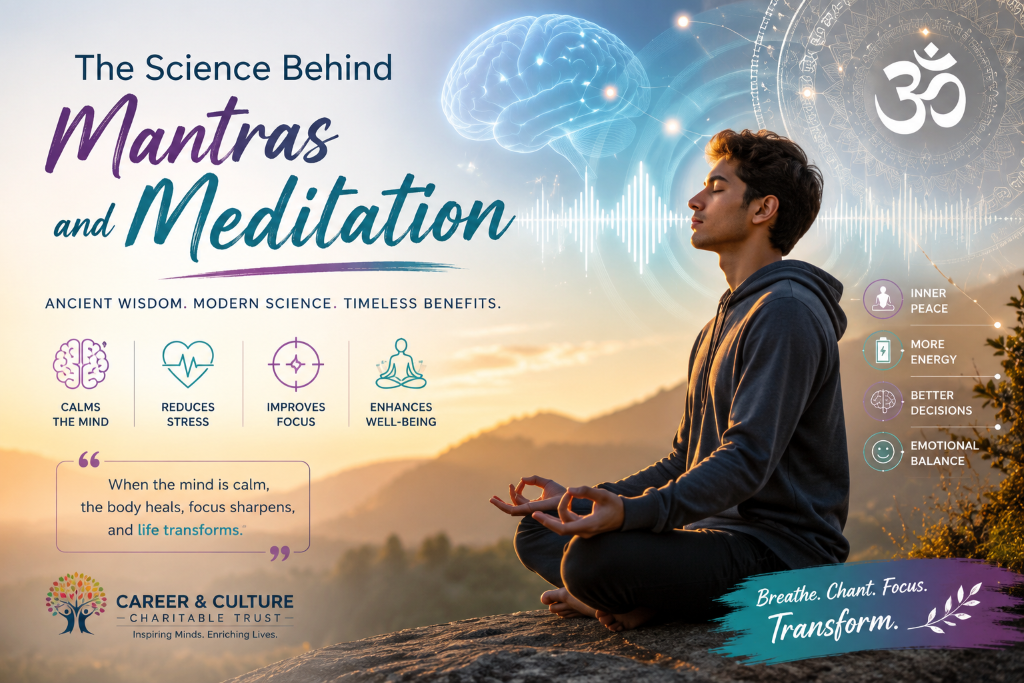
In today's fast-paced world, where constant notifications, academic pressure, career uncertainty, and social expectations have become part of everyday life, finding moments of peace can seem almost impossible. Many young people struggle with stress, anxiety, lack of concentration, emotional exhaustion, and an overwhelming sense of distraction. While modern technology has transformed the way we live, it has also increased the need for practices that help us reconnect with ourselves. This is where the timeless practices of mantras and meditation offer remarkable value. Far from being merely spiritual rituals, they are increasingly recognized by scientists, psychologists, and healthcare professionals as effective tools for improving mental, emotional, and physical well-being.
A mantra is a meaningful sound, syllable, word, or phrase that is repeated with intention and focus. The word itself originates from Sanskrit, where "Man" means mind and "Tra" means instrument or tool—making a mantra literally an "instrument of the mind." Whether it is a traditional Vedic mantra, a simple affirmation, or a peaceful phrase repeated silently, the purpose is the same: to calm mental chatter, improve concentration, and create inner balance. Meditation complements this process by training the mind to become aware of the present moment rather than constantly dwelling on the past or worrying about the future.
Modern neuroscience has revealed fascinating insights into what happens inside the brain during meditation and mantra chanting. Research has shown that regular meditation helps reduce activity in the brain's stress response while strengthening areas responsible for attention, emotional regulation, learning, and decision-making. At the same time, chanting mantras in a slow and rhythmic manner can activate the body's relaxation response, reducing heart rate, lowering blood pressure, and promoting deeper, more controlled breathing. These physiological changes help decrease the production of stress hormones such as cortisol while encouraging the release of chemicals associated with relaxation, emotional stability, and overall well-being.
One of the most remarkable benefits of mantra meditation is its ability to improve focus in an age dominated by constant digital distractions. Students often find it difficult to concentrate for extended periods because their attention is continuously divided between social media, notifications, and academic responsibilities. Practising mantra meditation for even ten to fifteen minutes each day can train the brain to sustain attention for longer periods, improving memory, learning capacity, and productivity. It is not about stopping every thought; rather, it is about gently bringing the mind back whenever it wanders, strengthening mental discipline over time.
Scientific studies have also highlighted the positive impact of meditation on emotional health. Individuals who practise meditation regularly often report lower levels of anxiety, greater emotional resilience, improved self-awareness, and better control over negative thoughts. Instead of reacting impulsively to stressful situations, meditation helps develop the ability to pause, observe emotions objectively, and respond thoughtfully. This emotional intelligence becomes especially valuable for young people navigating academic competition, relationships, career choices, and personal growth.
Beyond the mind, meditation also supports physical health. Improved sleep quality, stronger immunity, healthier blood pressure levels, reduced muscle tension, and increased energy are among the many benefits associated with consistent practice. As the body relaxes, it redirects energy from constant stress responses towards healing, recovery, and overall wellness. This holistic connection between mind and body explains why meditation is now widely incorporated into hospitals, wellness programs, educational institutions, and corporate workplaces around the world.
Despite its ancient origins, meditation is not tied to any particular religion or belief system. It is a universal practice that welcomes people of all backgrounds. Whether someone seeks spiritual growth, emotional balance, academic success, professional excellence, or simply a few moments of peace each day, meditation provides a practical path toward greater self-awareness and clarity. The power lies not in complicated techniques but in consistency. Even a few minutes of mindful breathing or mantra repetition each day can gradually create meaningful changes in one's thoughts, emotions, and habits.
For today's generation, success is no longer measured solely by academic achievements or professional accomplishments. True success includes mental well-being, emotional stability, healthy relationships, purposeful living, and inner peace. Mantras and meditation remind us that while the external world will continue to change rapidly, lasting strength comes from cultivating calmness within ourselves. Ancient wisdom, supported by modern science, teaches us that the mind is our greatest asset—and when we learn to train it with awareness and intention, we unlock the potential to live healthier, happier, and more meaningful lives.
At Career & Culture Charitable Trust, we believe that empowering young minds involves more than academic knowledge alone. Through our Mindful Youth Program, we encourage students and young adults to embrace practices that strengthen their emotional intelligence, resilience, character, and overall well-being. By combining timeless wisdom with scientific understanding, we aim to help every individual discover the power of a peaceful mind, a focused heart, and a purposeful life.